
· Michael Blair
Modern headlight lenses are polycarbonate, a plastic chosen because it is light and does not shatter. Polycarbonate degrades in sunlight, so every lens leaves the factory with a hard clear coating on the outside that blocks UV. That coating is what fails. Once it has broken down, the plastic beneath oxidizes, yellows and goes hazy, and the light output drops to a fraction of what it was.
What has happened to the lens
The factory coating wears from UV exposure, from road grit, from automatic car washes and from harsh cleaners. It fails first on the top and the outer edges of the lens where the sun hits hardest, which is why the haze starts there. Once it is gone, the polycarbonate itself oxidizes and the surface becomes a layer of yellowed, microscopically rough plastic that scatters light instead of passing it.
A Middle Tennessee car parked outside gets a full dose of summer sun, and lenses here commonly start to haze within five to eight years. The oxidation is a surface layer, which is why it can be removed. It is also why it comes back, because the removal takes the coating with it.
What restoration does
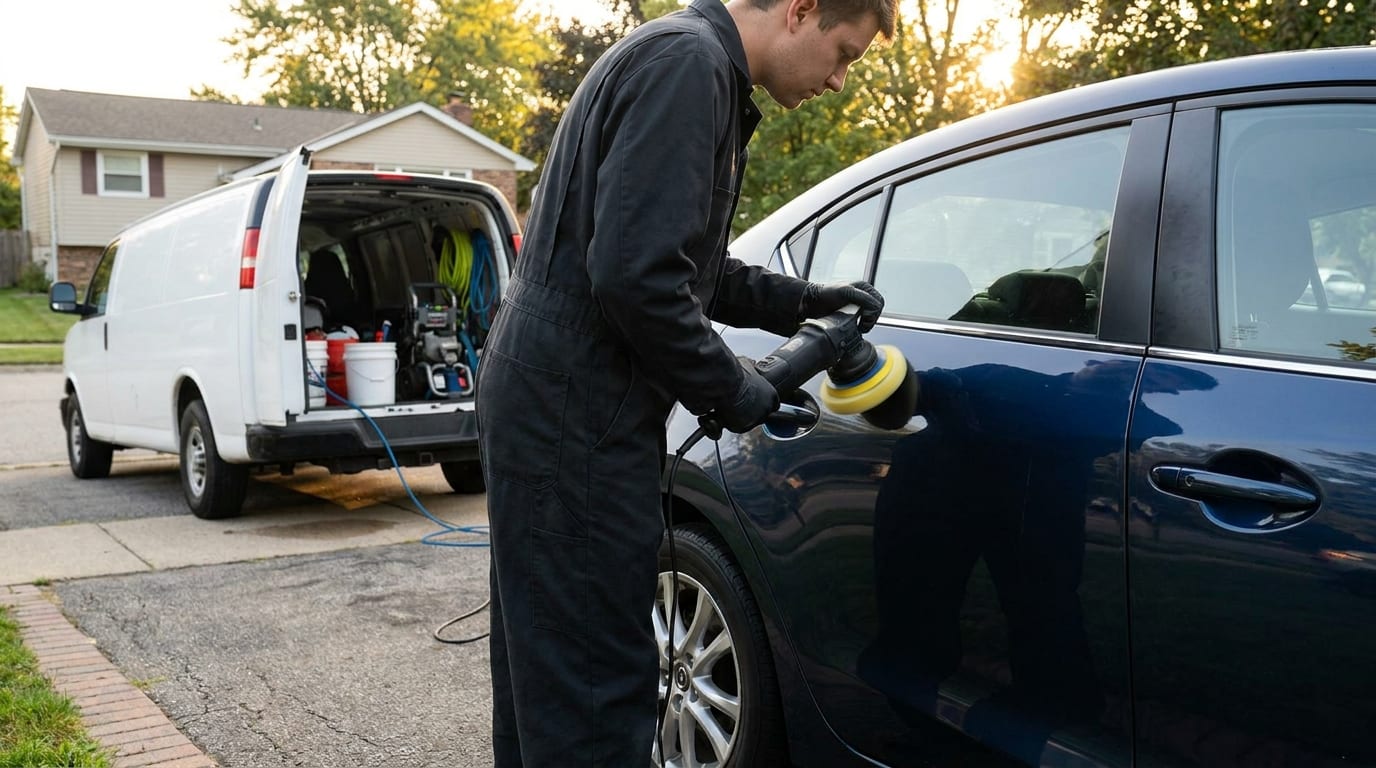
Restoration is sanding and polishing. The oxidized layer is wet-sanded off with progressively finer abrasives, then the lens is polished back to clarity with a compound. Done properly, the lens comes back to something close to new, and the light output with it. The difference between a kit in a driveway and a detailer is mostly the finer grit steps and the machine polishing, which give a clearer finish with fewer sanding marks.
At that point the lens is bare polycarbonate with no UV protection at all. This is the state the plastic was never meant to be in, and left like that it yellows faster than it did the first time, often within a few months. That is why so many restorations seem not to have worked.
- Mask the paint around the lens
- Wet sand through several grits to remove the oxidation
- Machine polish to clarity
- Apply a UV-blocking clear coat, which is the step that decides the life
The coating is the whole job
After polishing, the lens needs a new UV barrier. The options are a spray-on or wipe-on clear coat formulated for headlights, a two-part urethane clear like a body shop uses, or a ceramic coating designed for plastics. The urethane and the proper headlight clears give the longest life, often several years. Wipe-on sealants and waxes give months.
A restoration without a coating is a temporary clean. A restoration with a good coating, applied to a properly prepared lens in the right conditions, is a repair. When comparing prices, that step is the difference, and it is worth asking what will be applied and how long it is expected to last.
When restoration is the wrong answer
Hazing on the inside of the lens, from moisture that got past a failed seal, cannot be polished. Neither can deep crazing, the network of fine cracks that appears when the plastic has been degrading for many years, or yellowing that has gone all the way through. Those lenses are replaced. Replacement on many cars means the whole headlight assembly, which is why restoration is worth doing before the lens gets there.
Prevention is the coating again. Parking in shade or a garage, hand washing rather than the brush wash, and a UV sealant renewed once or twice a year keep a restored lens, or a new one, clear for far longer than the first factory coating managed.