
· by Michael Blair, Nashville's Mobile Detailing
A car parked outside in Middle Tennessee takes ultraviolet, heat, damp summer air, a heavy pollen season, bird droppings and tree sap. Each does something different to the finish. The sun gets most of the blame, yet the laboratory work on automotive clear coat says the humidity matters too, and that bird droppings do their damage in a way most owners don’t expect. Here is what the research shows, where it runs out, and what we do about each one when we detail a car in Nashville.
Why is damp summer air hard on car paint?
Researchers at the National Institute of Standards and Technology describe acrylic-melamine coatings as used extensively for automobile topcoats, and in their study of what water does to them they found these coatings break down in humid conditions even with no light at all. Pits formed in the film and deepened and widened the longer it was exposed, and the higher the humidity, the faster it degraded.
Sunlight adds to that. In a second NIST study, the same kind of coating sat under simulated sunlight at 50 °C (122 °F) at humidity levels from near zero to 90 percent, and the UV damage came faster and went further as the humidity rose. That was a lab test, not a car in a driveway, and it held the temperature fixed, so it tells us little about heat on its own. What it does suggest is that a Nashville summer, with strong sun and damp air together, is harder on a finish than the sun alone.
Polishing takes off a fine layer of clear coat, which is how paint correction brings back a finish that has gone dull while the clear coat is still sound. Once it is peeling or flaking, there is nothing left for us to polish, and we tell the owner that panel is a refinishing job for a body shop. A garage or a shaded spot cuts the hours of sun the paint takes, and a sealant or coating puts a layer on top.
Bird droppings and sap
Bird droppings usually get blamed on acid. A mechanistic study in the Journal of Coatings Technology and Research points elsewhere: the researchers put natural droppings and pancreatin, a digestive enzyme mix used as a stand-in, on an automotive clear coat and found highly etched areas from a catalyzed breakdown of the coating. Acid and metal ions contributed only weakly. The enzymes in the droppings did most of the damage.
The same group tested droppings against gum arabic, a tree gum, on clear coat laid over silver and black basecoats. In their paper on basecoat pigmentation they report that the droppings and pancreatin affected the coatings more severely than the gums did, and that the damage was worse on the black-basecoat samples that had been aged first. Sap from the trees over a Nashville driveway isn’t gum arabic, and we haven’t found research on it we would quote, so we handle it the way we handle droppings.
We can’t point you to a reliable figure for how many hours either one takes, so the advice is simply to get it off the hood as soon as you see it. We soak a dropping with a detailer spray, let it soften, and lift it with a soft microfiber cloth, because rubbing it off dry drags any grit in it across the paint.
- Bird droppings and sap: soak and lift as soon as you see them, never wipe dry
- Pollen and dust: rinse before anything touches the paint
- Park in a garage or in shade where you can
- A sealant or coating adds a layer over the clear coat
- Peeling or flaking clear coat: a refinishing job, not a polishing one
Pollen
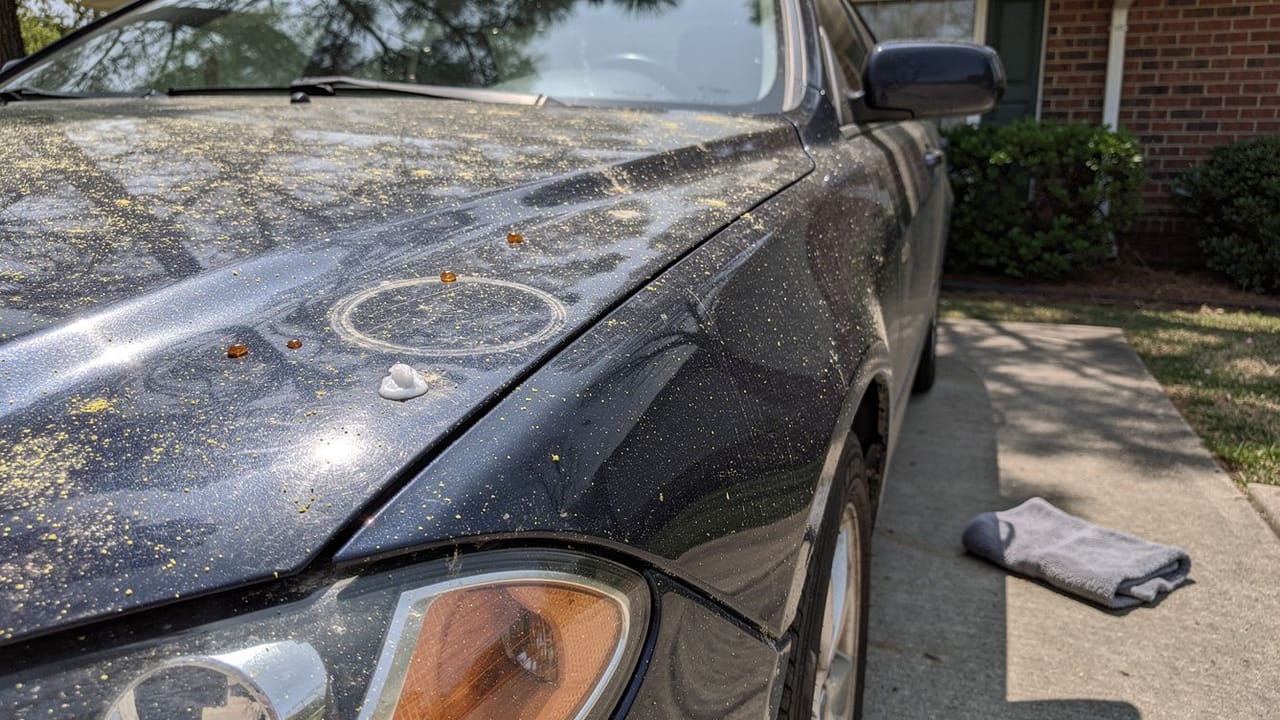
Spring here leaves a film of yellow pollen on anything parked outdoors. It gets called abrasive, though we haven’t seen a study that measures pollen scratching paint, so we treat it like any other dust on the surface. Wiped off with a dry cloth, the pollen and whatever grit is mixed in with it get dragged across the clear coat, and that can leave fine scratches.
Rinse first, every time, and if a full wash isn’t practical, use a detailer spray as lubrication. Our post on washing a car without putting swirls in covers the rest of the routine.
Does a sealant or ceramic coating stop etching?
A sealant or ceramic coating does not stop etching indefinitely. In our experience it puts a layer between the contamination and the clear coat, which gives you more time to get a dropping or a smear of sap off before it reaches the paint. We have no lab figure for how much time, and we don’t quote one.
On a car that lives outside in Middle Tennessee, that reaction time is the practical benefit. It is why our exterior detail finishes with a sealant, and why a ceramic coating goes on only after the paint has been corrected. If the finish on yours has started to dull and you aren’t sure whether there is clear coat left to polish, ask us for a free quote and tell us what you’re seeing.
Sources
- Nguyen, Martin, Saunders and Byrd, Mode, Mechanism and Model for Hydrolysis of Acrylic-Melamine Coatings in the Absence of UV Light, NIST (2001) — Acrylic-melamine coatings are used extensively for automobile topcoats and hydrolyze in humid conditions; pits formed, deepened and widened with exposure; degradation rate rose with relative humidity
- Nguyen, Martin, Byrd and Embree, Relating Laboratory and Outdoor Exposure of Coatings III: Effect of Relative Humidity on Moisture-Enhanced Photolysis of Acrylic-Melamine Coatings, Polymer Degradation and Stability (2002), NIST record — Coating exposed to simulated sunlight at 50 °C and humidity from about 0 to 90 percent; the rate and extent of UV damage increased with humidity
- Yari, Mohseni and Ramezanzadeh, A mechanistic study of degradation of a typical automotive clearcoat caused by bird droppings, Journal of Coatings Technology and Research (2010) — Bird droppings and pancreatin produced highly etched areas by catalyzed hydrolysis; acid and metal ions contributed weakly, enzymes were mainly responsible
- Ramezanzadeh, Mohseni and Yari, The role of basecoat pigmentation on the biological resistance of an automotive clearcoat, Journal of Coatings Technology and Research (2010) — Droppings and pancreatin affected the clear coat more severely than natural and synthetic gum arabic; effects more severe over a black basecoat after post-aging
FAQ
What Nashville Sun and Pollen Do to Paint — questions
How quickly do bird droppings damage paint?
We have not found a reliable figure in hours, so remove them as soon as you see them. Lab work on automotive clear coat found that the enzymes in droppings, more than their acid, drive the etching. Wet the dropping first with a detailer spray and lift it with a soft cloth rather than wiping it dry, which drags grit across the paint.
Is pollen bad for car paint?
Mostly in the way any dust is. Wiping a pollen-covered car with a dry cloth drags the pollen and any grit mixed in with it across the clear coat, and that can leave fine scratches. Rinse before touching the paint, or use a lubricating detailer spray if a full wash is not practical.
Can sun damage to paint be polished out?
Sometimes. Polishing takes off a fine layer of clear coat, so it can bring back a finish that has gone dull while the clear coat is still sound. Once the clear coat is peeling or flaking, there is nothing left to polish, and that panel needs refinishing at a body shop. Shade and a sealant or coating are the ways to slow it down before it gets there.
How do you protect car paint from the sun?
Cut the hours of sun first: a garage or a shaded spot does the most. A sealant or ceramic coating then adds a layer over the clear coat and buys time to get droppings and sap off before they reach the paint. Rinse pollen rather than wiping it dry, and polish dull paint before the clear coat starts peeling.