
· by Michael Blair, Nashville's Mobile Detailing
Book a mobile car wash and the car gets clean where it sits. What nobody mentions on the booking call is the water. A hand wash ends with soapy rinse water carrying road film, brake dust off the wheels and whatever oil has dripped onto the pavement, and on most driveways in Middle Tennessee that water runs downhill to the street. Here is where it goes after that, what Metro Nashville’s code says about it, and what to ask before anyone washes a car at your house, including us on an exterior detail and hand wash.
What runs off a car washed in a driveway
Stand at the bottom of a driveway after a hand wash and the water is never clear. It holds the wash soap, the grime the soap lifted, a gray tint from the wheels, where brake dust collects heaviest, and often a faint sheen. That sheen usually comes from the pavement rather than the car: a concrete driveway that has had cars parked on it for years has oil and fluid drips worked into the surface, and a hose loosens some of it every time.
Wheels and tires are the dirtiest water of the job. They are also cleaned closest to the ground, so their rinse lands right on the pavement. A wash done for pay at your house is a small version of what a car wash bay handles every day, minus the drain that bay was built around.
None of that is dramatic for one car on one Saturday. The question is where it ends up, and the answer depends on what is at the bottom of your driveway.
The curb drain does not go to a treatment plant
Most people assume the grate in the street goes to the same place as the kitchen sink. In Davidson County it does not. Metro Water Services’ Mobile Carpet Cleaner Reference Guide explains that storm drains and roadside ditches are part of the separate storm system and carry water to streams, not to the sanitary treatment plant. Metro’s pollution prevention page puts the end of the line plainly: what goes into those drains eventually flows into the Cumberland River.
Metro’s rule on it is in the illicit discharge ordinance, Metro Code 15.64.205. It declares non-stormwater discharges into community waters unlawful, then lists the exceptions: water line flushing, lawn irrigation, air conditioner condensate and others. One of them is individual residential car washing. A homeowner washing the family car in the driveway is named. A business washing cars for money is not on that list. The ordinance does not single out mobile detailers by name, so the accurate way to say it is that commercial washing is not among the exceptions. The same page sets civil penalties of not less than fifty dollars and not more than five thousand dollars per day of violation.
Metro’s carpet cleaner guide is the closest thing the city has published on cleaning work done at a customer’s address. It was written for carpet cleaners, not car washing, but its logic carries over: nearly all discharges from that kind of mobile work into the storm system count as illicit discharges under 15.64.205, and waste wash water belongs down an inside drain, such as a sink, toilet or floor drain, that leads to the sanitary sewer.
That is Metro’s rule for Nashville and Davidson County. If you live in Franklin or Murfreesboro, you are in a different city with its own stormwater program, and nothing here describes what those cities require. Ask the city’s own stormwater office if you want their answer.
Catching the water, or using less of it
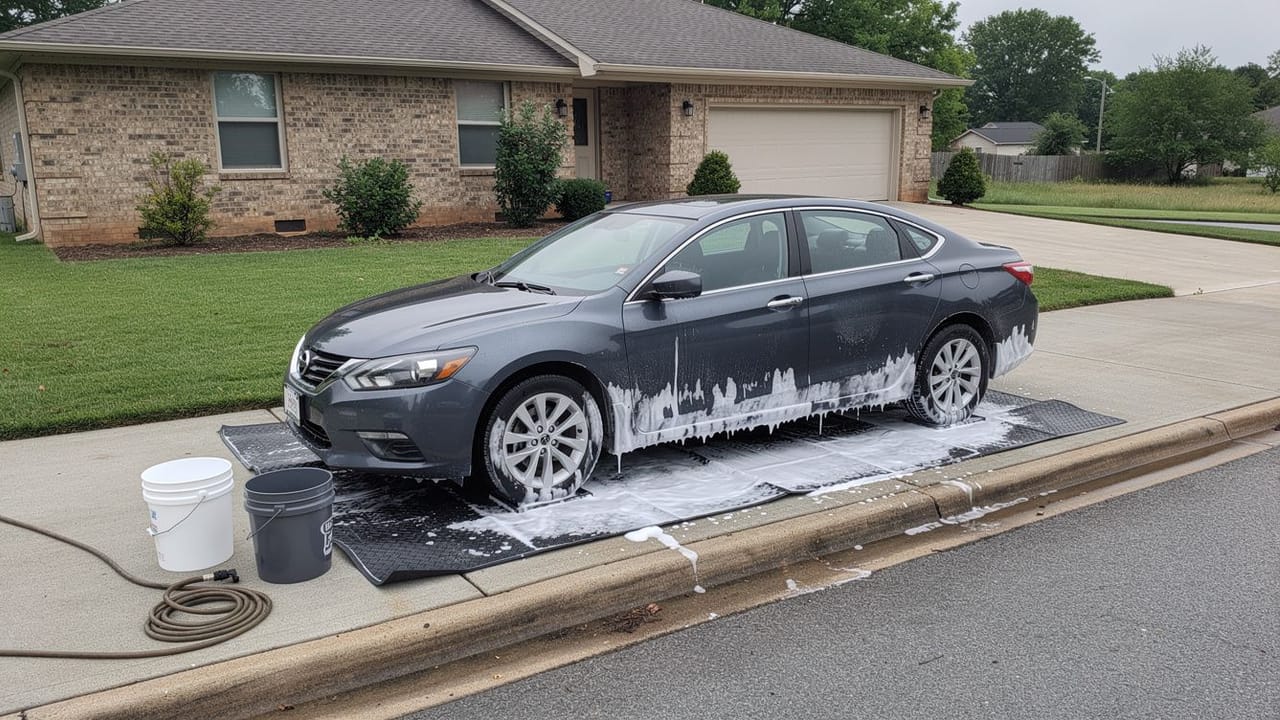
There are two practical ways a detailer keeps a driveway wash out of the gutter. The first is to catch it. A containment mat is a heavy flexible sheet with raised edges that the car is parked on before the wash starts. The rinse water collects on the mat instead of running down the slope, and it is pumped or vacuumed into a tank on the truck. What happens to that tank afterward matters as much as the mat: the point is that it ends up in a sanitary sewer connection, not tipped into a ditch down the road.
The second way is to make less water in the first place. Rinseless and waterless washes use a lubricating solution and microfiber towels in place of a hose rinse, so a lightly soiled car can be cleaned with a bucket or a spray bottle and the dirt leaves on the towels. They suit a car that is dusty or pollen-coated, not one caked in mud or red clay from a construction road, where a proper rinse is the only safe way to get grit off before anything touches the paint. Wiping heavy grit across clear coat is how swirls go in, which is the subject of our post on washing a car without putting swirls in.
Metro’s own advice to homeowners is a third option that works for a family car: wash it on the grass, so the dirt, oil and soapy water soak into the lawn instead of running to a storm drain. For a detail with wheel cleaner and degreaser, grass is a poorer fit, since those products are stronger than a bucket of car soap and a lawn is not where you want them. That is one more reason the method should be settled before the hose comes out.
What to ask before a mobile wash at your house
You do not need to know the code to book well. A few questions on the phone tell you whether a mobile detailer has thought about the water at all, and the answers are short if they have. Earlier we covered the space, shade and time a detailer needs from you in what a mobile detailer needs from you; these questions are about what they take away.
- Where does the rinse water go when you wash a car on my driveway?
- Do you put a containment mat under the car, and what do you do with the water you collect?
- Is it emptied into a sanitary sewer connection, and where?
- Can my car be done with a rinseless method, or does it need a full rinse?
- What do you use on the wheels, and does that rinse go on the mat too?
- If my driveway drains straight to the street, how will you set up?
Sources
- Metro Nashville Water Services, Illicit Discharge Ordinance (Metro Code 15.64.205) — Non-stormwater discharges to community waters are unlawful; individual residential car washing is a listed exception; civil penalty of $50 to $5,000 per day of violation.
- Metro Nashville Water Services, Pollution Prevention — Wash a car on the grass so dirt, oil and soapy water stay out of storm drains, which flow to the Cumberland River.
- Metro Water Services NPDES, Mobile Carpet Cleaner Reference Guide (PDF, 2011) — Storm drains carry water to streams, not the treatment plant; waste wash water from mobile cleaning goes down an internal drain to the sanitary sewer. Written for carpet cleaners, cited here for its logic only.