
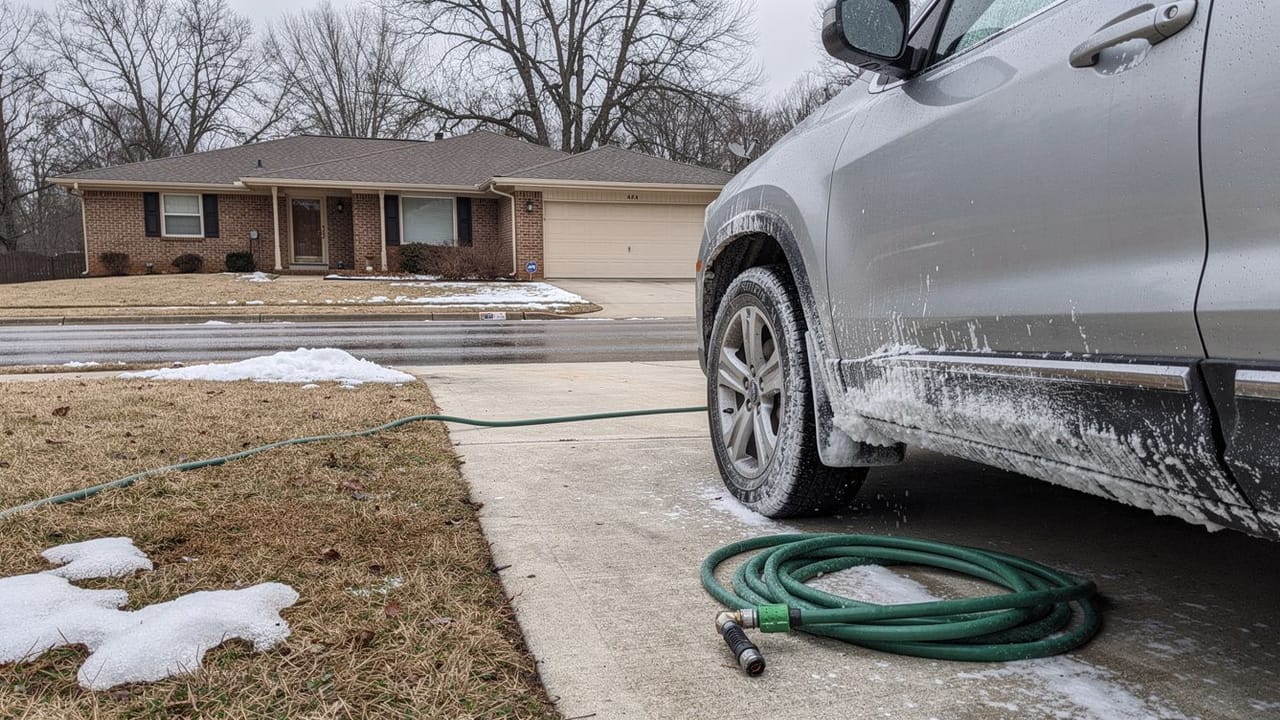
· by Michael Blair, Nashville's Mobile Detailing
Middle Tennessee road crews pre-treat with liquid brine ahead of winter weather. TDOT’s winter maintenance page describes its salt brine as water, salt and other additives, put down before the anticipated storm arrives so it starts working as soon as snow falls, and says pre-treating lets the state drastically reduce the salt it has to spread. Metro does the same in town: NDOT’s January 2026 pre-treatment notice lists 100,000 gallons of brine solution and 40,000 gallons of calcium chloride among its supplies for the season. Whether all that is harder on your car than rock salt comes down to what the liquid does once it is on the vehicle.
Is brine worse for a car than rock salt?
Chemically, no. Vermont’s highway maintenance director wrote to legislators in 2015 that salt brine is salt and water made from the same rock salt his trucks spread, and that rock salt turns into brine on the road anyway as it melts snow and ice, which still splashes up onto passing cars. Rock salt also bounces, and he put the share that lands in the ditch as high as 30%. The studies he had seen pointed to how much chloride goes down, not how it is applied.
Where it goes is a different matter. Because brine is already liquid when it is sprayed ahead of a storm, he allowed that it may get into places on a vehicle it never reached before. The additives matter too. The stickiness Vermont drivers complained about came from a magnesium chloride and molasses blend rather than the brine itself, and Idaho’s 2014 research review on salt and brine explains that magnesium chloride and calcium chloride attract water, so in humid conditions they hold onto metal longer than road salt does. TDOT doesn’t name its additive, but calcium chloride is on Metro’s list.
Where does brine damage a car?
Underneath. When an Alaska DOT&PF study published in 2025 asked its maintenance districts which parts corrode, the answers kept naming frames, the underside, wiring and brake components. Brake lines are the ones to know about. In Kia’s 2025 service campaign for brake line corrosion on 2014 to 2019 Souls, the company says the corrosion can take many years to develop when road salt isn’t regularly flushed from the underbody, and that the signs are low brake fluid, a pedal that slowly goes soft, or the brake fluid warning light.
Tennessee is not one of the 28 high road salt states on Kia’s list, though Kentucky and Missouri are. NWS Nashville’s climate records put normal snowfall at 4.7 inches a year, with 67 days a year at or below freezing, and the brine trucks go out whenever a storm is forecast. The exposure here is lighter than up north but it is not zero, and because the parts at risk sit under the car, it is easy to forget about until the brakes or the wiring give trouble.
- Rinse the undercarriage, not just the paint
- Wash soon after brine has been on the roads, on a day the car can dry
- Keep drain holes in rockers and doors clear
- Do not skip a wash because the car looks clean
- Have the underside checked at routine service
Washing in the right way and at the right time
The undercarriage is the part that matters, and a wash aimed at the paint never touches it. Idaho’s review found that agencies frequently recommend regular vehicle washing to get corrosive chemicals off cars and trucks, and the Alaska study lists washing vehicles as often as is feasible among its best practices. A touchless wash with an undercarriage rinse does it, or a hose worked underneath at home. If you use a pressure washer, keep the pressure low; the Alaska study’s literature review mentions washing with hot water at low pressure.
Drying matters as much as rinsing, which is why that same review pairs the wash with fast drying. We pick a day above freezing with enough daylight left for the car to dry, and we’d rather rinse soon after a stretch on treated roads than save it all for one detailed wash in March. Idaho’s review concedes that washing isn’t always practical in winter, so several quick undercarriage rinses through the season are the realistic goal. When spring comes, an exterior detail with clay and sealant takes the rest of the winter off the paint.
Protection that is worth the money
On paint, a sealant or a ceramic coating put on before winter is nice to have, but it protects the part of the car brine threatens least. Whether a coating suits your car is its own question, and our post on whether a ceramic coating is worth it takes it up.
Underneath is where protection earns its money. The Alaska study recommends barrier protection after washing, and among the products in its tables is an oil-based undercoating sprayed at high pressure to push it into seams and cracks, with the maker recommending a new coat every year. Before paying for any undercoating, ask what the product is, how it goes on and how often it needs redoing. And if you’d rather someone else got the brine off this winter, ask us for a free quote.
Sources
- Tennessee Department of Transportation, Winter Maintenance — Salt brine of water, salt and other additives applied before the storm; pre-treating drastically reduces salt use; salt and plows once snow and ice accumulate
- Metro Nashville DOT, NDOT to Begin Pre-treating Nashville Roads Tomorrow Morning (January 2026) — Brine pre-treatment of routes; 100,000 gallons of brine solution and 40,000 gallons of calcium chloride for 2025-26
- Vermont Agency of Transportation, S. Rogers to the House Government Operations Committee, AOT Pilot Program (2015) — Brine is not chemically more corrosive than rock salt; rock salt becomes brine on the road and splashes onto vehicles; up to 30% of rock salt bounces into the ditch; corrosion tracks chloride quantity; pre-mixed liquid may reach new places; stickiness from a magnesium chloride and molasses additive
- Idaho Transportation Department, RP 231, Impacts of Using Salt and Salt Brine for Roadway Deicing (2014) — Magnesium and calcium chloride are hygroscopic and stick to metal longer than road salt in humid conditions; agencies recommend regular vehicle washing; manual washing not feasible in winter
- Alaska DOT&PF and Western Transportation Institute, Corrosion Concerns in Alaska to Personal and Commercial Vehicles caused by Chlorides used in Winter Operations (2025) — Frames, underside, wiring and brake components named as corroding parts; washing as frequently as feasible, barrier protection after washing and routine inspections; hot water at low pressure with fast drying; oil-based undercoating pushed into seams, reapplied annually
- Kia America, 2014-2019 MY Soul Brake Line Corrosion Voluntary Service Campaign (SC334) Q&A, filed with NHTSA (2025) — Brake line corrosion develops over years when road salt is not regularly flushed from the underbody; symptoms; the 28 high road salt states, which do not include Tennessee
- National Weather Service Nashville, Nashville Climate Records — Normal annual snowfall 4.7 inches; 67 days a year with a minimum at or below 32°F
FAQ
Road Brine and Winter Car Care in Tennessee — questions
Do I need to worry about rust in Tennessee?
Less than in the heavy road salt states, and Tennessee is not among the 28 that Kia counted as high salt states for its Soul brake line campaign. Brine still goes down here before forecast storms, so cars pick up some salt even in a mild winter. The parts at risk are underneath, such as frames, wiring and brake components, which makes it easy to ignore until something fails.
How often should I wash the car in winter?
As often as is practical while there is salt on the roads, which is what transportation agencies advise, and Kia’s wording is that the underbody should be regularly flushed. We aim to rinse soon after driving on treated roads, on a day the car can dry. Salt underneath does not show from outside, so a clean-looking car is not the test.
Is an undercarriage wash at an automatic car wash enough?
It is far better than nothing and the easiest option most people have, because rinsing the underside is the part that matters. We have not seen a test of how far those sprays reach into rocker panels and other closed sections, so we treat them as routine upkeep rather than complete protection. An oil-based undercoating pushed into the seams, reapplied each year, is the usual next step.
Does Tennessee salt its roads?
Yes. TDOT pre-treats with salt brine, water, salt and other additives, ahead of forecast storms and spreads salt once snow and ice build up. In town, Metro’s transportation department listed 100,000 gallons of brine solution and 40,000 gallons of calcium chloride among its supplies for the 2025-26 season.