
· by Michael Blair, Nashville's Mobile Detailing
Ceramic coatings are sold with a lot of claims. What the makers’ own data sheets promise is narrower: paint that beads water and shrugs off chemicals for a few years, which changes how the car is kept clean rather than making the paint invulnerable. Here is what we tell people who ask about our ceramic coating service before they book it.
What they do
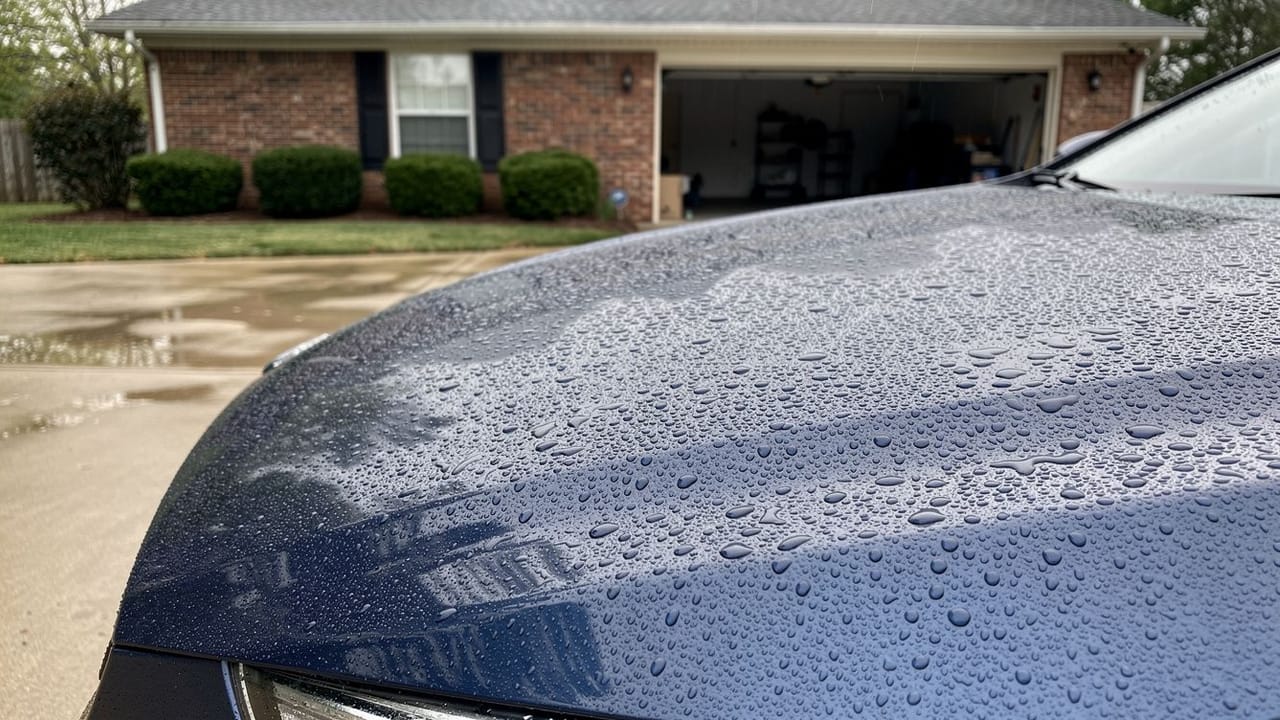
A coating is a thin layer cured onto the clear coat. 3M’s technical data sheet for its Ceramic Coating 39901 describes water beading, chemical resistance against road salt, harsh detergents and acid rain, and a life of up to five years with proper care and maintenance. The same sheet says tree sap, bug spots, bird droppings and brake dust come off a coated surface more easily than an uncoated one. Those are the manufacturer’s figures; we have not found an independent test that checks them.
Why that matters here: acid on a hot panel does real damage. Ford researchers presenting at the AVS symposium in 1998 traced acid-rain damage on automotive clearcoats to the chemical bonds of the cured finish breaking down, and in a 1992 EPA-sponsored study of acidic drops on car finishes the damage grew with continued heating, mostly under the residue each drop left as it dried. On a summer car we get droppings, sap and bug residue off the paint the same day, coated or not, and our post on Nashville sun and pollen covers that routine.
What doesn’t a ceramic coating do?
They do not stop scratches, swirl marks or rock chips. XPEL’s data sheet for Fusion Plus Premium puts the cured coating at 21 to 22 micrometers, under a thousandth of an inch, and its 9H rating comes from a pencil hardness test, which is a long way from armor. Neither maker claims scratch or chip protection, and 3M’s own application steps warn that a reused cloth can let cured coating scratch the paint. We wash a coated car with exactly the care we give any other, the method in our post on washing without swirl marks.
They also do not end washing. 3M ties its five-year figure to proper care and maintenance, so a coated car still gets washed; it just comes clean with less effort.
- Chemical and stain resistance, by the makers’ own sheets
- Easier washing
- No meaningful scratch or chip protection
- Best applied after paint correction
- Needs correct washing to maintain
Preparation is the whole job
A coating goes on over whatever the finish looks like that day, swirls and haze included, and it is meant to stay for years. So we do paint correction first and coat second. Neither data sheet sets that as a rule; it is simply how we work.
Weather is part of the prep on a mobile job. 3M asks for surfaces above 60°F and at least four hours out of water after application, and XPEL gives six hours before the car gets wet and three days to cure. In a Middle Tennessee winter that can mean waiting for a mild stretch. If two coating quotes are far apart, ask whether both include correction and how much of it, then send us the car’s details for a quote.
Is paint protection film better for rock chips?
For rock chips, film is the answer rather than a coating. 3M’s bulletin for its Protection Wrap Film describes a polyurethane film 0.19 to 0.23 mm thick with its adhesive, roughly nine to ten times the coating, sold for protection against rock chips, scratches and stains. We would put it where stones hit first: the hood and front bumper.
The two work together. 3M says its coating is designed to protect paint, trim, film, vinyl wraps and wheels, so film on the impact areas with a coating over the whole car is a pairing the coating’s maker plans for.
Sources
- 3M, Ceramic Coating 39901 Technical Data (January 2021) — Water beading; chemical resistance to road salt, harsh detergents, acid rain; up to five years with proper care; contaminants removed more easily; reused cloths can scratch; above 60°F, four hours out of water; designed to protect paint, film, vinyl wraps
- XPEL, Fusion Plus Premium V2 Technical Data Sheet (R20240510) — Coating thickness 21 to 22 micrometers; pencil hardness 9H; six hours before wet, three-day cure; designed to withstand years of driving
- Schmitz, Holubka and Xu (Ford Motor Co.), acid rain degradation of automotive clearcoats, AVS 45th International Symposium (1998) — Acid-rain damage to clearcoats traced to breakdown of the cured film’s crosslinks
- White et al., Physical Damage Formation on Automotive Finishes Due to Acidic Reagent Exposure, EPA/600/A-92/240 (1992) — Damage from acidic drops grew with continued heating, mostly under the dried residue
- 3M, Protection Wrap Film Product Bulletin (Revision C, January 2026) — Polyurethane film 0.19 to 0.23 mm with adhesive; protection against rock chips, scratches and stains
FAQ
Is a Ceramic Coating Worth It on Your Car — questions
Does ceramic coating prevent scratches?
No, and this is the most oversold claim. A professional coating is roughly 21 to 22 micrometers thick by XPEL’s figure, and neither XPEL nor 3M says it stops scratches or chips. Stones will still chip a coated car, and it still needs careful washing. For chips, paint protection film is the product made for the job.
How long does a ceramic coating last?
3M rates its professional coating for up to five years with proper care and maintenance, and XPEL says its coatings are designed to withstand years of driving. Those are the makers’ own numbers, not independent tests, and both depend on how the car is looked after. We tell owners of coated cars to skip brush car washes and follow the care sheet they were given.
Why is professional coating so expensive?
Because a professional coating usually comes after paint correction, and correction is hours of machine polishing across the whole car. The coating goes on over whatever the paint looks like, so the swirls come out first. When two quotes are far apart, ask whether both include correction and how many stages.
How long does a ceramic coating take to cure?
It depends on the product, so read its sheet. 3M asks for surfaces above 60°F and at least four hours out of water after application, while XPEL gives six hours before the car gets wet and three days to cure fully. In a Middle Tennessee winter, that can mean waiting for a mild stretch before coating.